

What Size Bike Frame Should I Get
The ultimate guide for for choosing the right bike size for y'all. What is the bike frame size and how to pick the right one for different types of bikes (city cycle, route bike, mount bike, kids bikes and more).
What size of bike is right for me?
You lot wouldn't believe how difficult it is to respond this question correctly. Nosotros did all the work for you though, and behold, you are about to read the ULTIMATE Bicycle SIZING GUIDE.
"How many inches are the wheels?"
– the most common Mistake people make when asking about bike sizes
You may notice that in our filters, we have this sizing for choosing the right wheel:
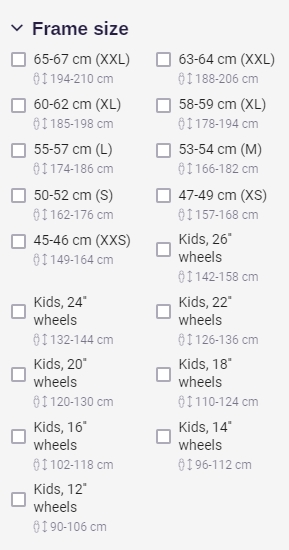
Ssssh! Let u.s.a. tell you a undercover though: this is not 100% universally optimal. Why?
Considering:
1) People are different.
2) Bikes are different.
3) Relationships between people and bikes are dissimilar.
Wut?
1) Overall body height is i thing. But even if y'all are say 175 cm tall, your legs tin be anywhere betwixt 0 cm and 150 cm. (Ok, 150 cm legs and so head would be pretty weird…)

Anyway, leg (and even arm) length makes a big deviation for cycling.
2) Mount bikes, tricycles or regular comfortable metropolis bikes all take different purpose, and hence need to be congenital differently. That of course brings multifariousness in sizing.
3) It also makes a divergence if you lot apply a route bike for long distance workouts or you plow information technology into a fixie and use it to stroll the metropolis streets. In other words, it depends HOW you use your bicycle (and how you want to experience when doing that), besides.
Permit's stay smart though.
Unless you're:
- picking a top-grade performance route or mountain bike, or
- you REALLY care almost your own comfort (eastward.one thousand. for medical reasons – having problem with your back or legs),
bike sizing is actually quite unproblematic and you probably don't need to spend hours with measuring calculations.
On the other manus, if you're a performance biker or take severe medical bug, information technology might just make sense to invest extra time and effort in getting a perfectly fitting cycle. Even if that's the instance for you lot, picking the correct size is not the hardest matter. Y'all'll mainly need to do a proper "bicycle plumbing equipment" (adjust the bike to your needs) afterwards – that is what makes a lot of departure. We'd recommend a performance bike shop for that (that is, a bike shop offering a lot of futuristic-looking race or mountain bikes), those tend to have the equipment and staff well educated on this topic. Feel costless to achieve out to us and we'll help you find one.
Speaking of the regular wheel SIZING though – what should you expect for?
What should yous measure?
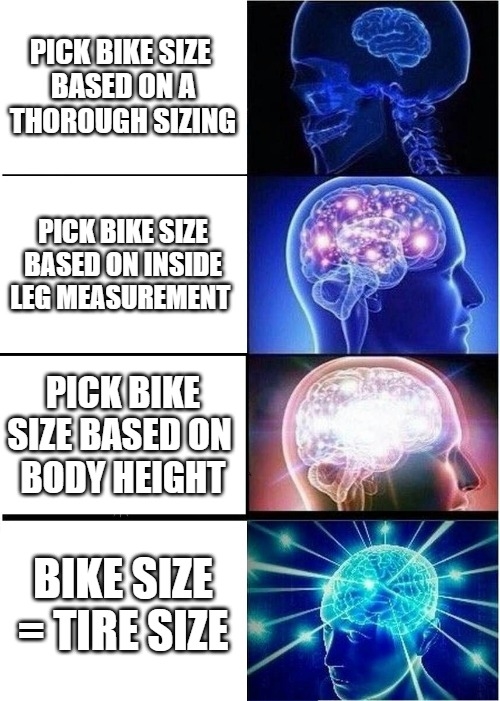
Need one matter to remember? Unless y'all are ownership a kid'southward wheel, Exercise Non THE PICK BIKE SIZE BASED ON Bicycle SIZES – it is like to picking a bus based on information technology'southward color. There's no real logic in that.
This is a seat tube length or a "frame size":

Frame size (seat tube length) is a decent size indication of a bike fit for person.
This is wheel (or tire) size:
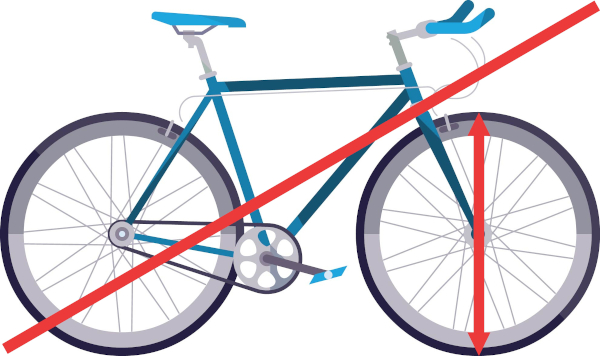
Simply very rarely the appropriate size of bikes is given past bike size. (Namely, kids bikes are classified like that.)
For most cases, y'all should compare your LEG INSEAM (or Full Torso Meridian if you lot actually don't intendance that much) to the seat tube length ("FRAME SIZE").

WHY? Because then y'all are comparing comparable lengths. When sitting on a bike, your leg inseam ("leg length") volition in reality be stretched between the seat and the pedal. And because leg inseam (A) and trunk height (B) are typically similar for many people, you tin can extrapolate the B/A and assign "correct frame sizes" to sure body heights.
The rest of the wheel is measured and built in a like way depending on the bicycle's purpose. So on metropolis bikes, the top frame tube length will be in sure ratio to the seat tube length so that y'all don't need to stretch also much. Whereas on road bikes the ratio (and frame shape) will be unlike to ensure you are in aerodynamic position when riding the bicycle. This is how it works:

So:
one) First thing is choosing the right bike type. (Non sure how to do that? Check our guideline!)
ii) Second footstep is choosing the right bike size.
three) The last thing so is adjusting ("plumbing fixtures") the cycle to your specific needs.
Choosing the right size is important, but it'south not THAT much of a big deal because you lot can do a huge difference with the final "bike plumbing equipment" adjustments. Want more detailed information? See the box at the bottom of this articled for advanced info.
What's the magic formula then?
Well, we need to distinguish betwixt three chief types of bikes: metropolis bikes (also valid for classic Dutch type – "omafietsen", and other with straight posture when cycling), road bikes and mountain bikes.

City bikes - CM
*Less than ~155 cm tall? Check out the kids sizes. Same bikes, simply cheaper!
City bikes - INCHES
*Less than ~iv'12" alpine? Check out the kids sizes. Same bikes, only cheaper!
Falling in between sizes? Then remember the smaller the frame, the more than dynamic/faster riding style information technology supports, while larger frame size provides you with more than comfort while riding.
Aside from the table, you tin can also use the usually know formula:
...but why bother, you got the table above ?

Search metropolis bikes >

Road bikes - CM
Before getting into the details here, a major disclaimer: at that place is a whole "science" of cycle geometry (related to cycle fitting, as already mentioned in a higher place) that can throw you off easily. Buying your get-go bike? Take it all with a pinch of salt (including this commodity and tabular array below!) and just endeavor and find a bike that'll roughly fit you and mainly that you will experience well on. That could take a couple tries, no mode effectually this. (PRO TIP: Follow the advice of manufacturers, they usually know what/who exactly is the bike made for). Once you lot start actually using it, you'll learn what actually works and what doesn't for y'all personally.
Looking to brand things harder for yourself right from the start (or but want a sneak peek into what lies alee?) Check this video most bike geometry.
*Less than ~155 cm alpine? Cheque out the kids sizes. Same bikes, but cheaper!
Road bikes - INCHES
*Less than ~iv'12" tall? Cheque out the kids sizes. Same bikes, but cheaper!
Falling in between sizes? Then recall the smaller the frame, the more than dynamic/faster riding style it supports, while larger frame size provides you with more than comfort while riding.
Aside from the table, you tin can as well use the commonly known formula:
...only why bother, you lot got the table above ?

Search road bikes >

Mountain bikes - CM
*Less than ~155 cm tall? Bank check out the kids sizes. Same bikes, just cheaper!
Mountain bikes - INCHES
*Less than ~4'12" alpine? Check out the kids sizes. Same bikes, but cheaper!
Falling in between sizes? Then call back the smaller the frame, the more than dynamic/faster riding mode it supports, while larger frame size provides you with more than comfort while riding.
Bated from the table, you lot can too use the usually know formula:
...simply why carp, you got the tabular array above ?

Search mountain bikes >
Special cases
There'south a couple of special bike types which take their sizes set up in a different way: well-nigh notably kids bikes, folding bikes and BMX. Bated from those, there's a enough of other bike types with a similar effect, but we'll devote a split up article to those peculiar (read: actually REALLY interesting) bikes.
Kids bikes
Kids bikes are equally the just bike blazon classified by wheel size. It is because the frames are so small that different wheel sizes but make bigger size steps than the frames.

Search kids bikes >
Folding bikes
Folding bikes are the easiest to size – manufacturers typically stick to the "ane size fits all" approach. And while folding bikes DO come in different wheel sizes (16, 20, 24, 26 and 27.v″ with 20" being the most popular), this doesn't reflect in variability for user height. In other words:
At that place is NO SIZING for folding bikes.
We even put it in a tabular array for those who skip the text:
Folding bikes - CM
Folding bikes – INCHES

Search folding bikes >
BMX
BMXs size is measured differently – information technology is the acme tube size. Top tube is the superlative part of the frame that connects the head tube (forepart of the bike) with the seat tube.
Bicycle sizes as well play a role, BMX bikes come in 12-24" wheel sizes (xx" beingness the standard). Typically, 16 inch wheels go for kids BMXs, xviii inch wheels are for pocket-size freestyle bikes, xx is the standard for most BMX bikes and 24 is usually only for cruiser bikes. But simply like with "ordinary" bikes, you shouldn't pick BMX based (only) on a wheel size.
Aside from a full general fit, you should likewise consider what you want to use the bike for. Just like with other bikes, the smaller the size, the more active you will exist, but the less stability will the bike provide. This is how it translates to a specific use of your BMX:
Park
Park riders typically prefer more responsive bikes. Then shorter height tube, chain stay and a steeper head tube angle. Option slightly smaller size from our table above.
Trails
Trail/dirt riders usually like bigger and more than stable bikes. Then, a longer top tube, concatenation stay and a slacker caput tube angle. This should give your ride more stability and comfort fifty-fifty on big jumps.
Street
Street riders typically pick something in between, depending on their personal preference. Street BMXs are typically a bit sturdier to endure grinding and flat landings.

Search BMX
Fitting the bike
Frankly, choosing your size is the piece of cake part. In one case you're through with that, you demand to actually Observe IT (which is sometimes the hardest thing on the whole process – you lot can start with our market place ?) and Test IT properly. This article volition tell yous more well-nigh how to exercise that.
One time yous actually got the bike, the real "alchemy" starts – Plumbing equipment YOUR NEW Bike specifically to your needs. That means adjusting all its movable parts and somewhen replacing those that are hands replaced so that the bike fits you like a glove. Nosotros're preparing an article on this topic, but let the states say 1 thing here: every bit long equally yous are in the right ballpark with the size,
you tin can practise more "magic" with proper fitting than with spending eternity with picking/searching for the super-optimal size.
Advanced BIKE FITTING BOX
If you lot spend a lot of time on your bike – call up ca 2+ hours per average ride/conditioning, or 12+ hours per week – or for any reason you REALLY care about having your bike perfectly fit you, these are the basics.
Central things to consider when fitting your bike are CONTACT POINTS. Contact points are places where you (rider) come up in contact with the wheel.

Depending on a bike type, your preferred riding fashion (position) and your body constitution, you need a bike with different distances and angles betwixt the contact points. This is a good illustration of how the principle works:

There are many things you should consider (and eventually fix up) on a bike to accomplish the optimal fit: saddle height, horizontal position in the seat postal service ("fore/aft position") and angle, headset peak, angle, stem length etc.
This is a cool video showing a bike set upwardly by a professional (with some absurd tips on the side):
Then you can use different equipment based on your setup – for instance, unlike seat types (shape, hardness) or handlebar types fit different riding styles. Every bit mentioned in a higher place though – those things are mainly of import for advanced bikers and/or cyclists with specific needs.
In that location's a whole "science" around bike fitting though, so nosotros'll become in more detail in a unlike commodity.
Expert luck and have fun! ?
Find OUT More:
How to cull (and check) a second-paw cycle
Bicycle locks: How practice I cull the correct one?! The ultimate guide.
Frame number: The real hero of the cycle theft battle & how it tin save your bike
Anti-theft i.0: The basics of bicycle locking
The Science of Wheel Locking: Outsmart the Thieves!

What Size Bike Frame Should I Get,
Source: https://bikefair.org/blog/guide-how-to-choose-the-right-bike-size
Posted by: warrenbrines.blogspot.com
0 Response to "What Size Bike Frame Should I Get"
Post a Comment